From professional dialogue to real-world evaluation
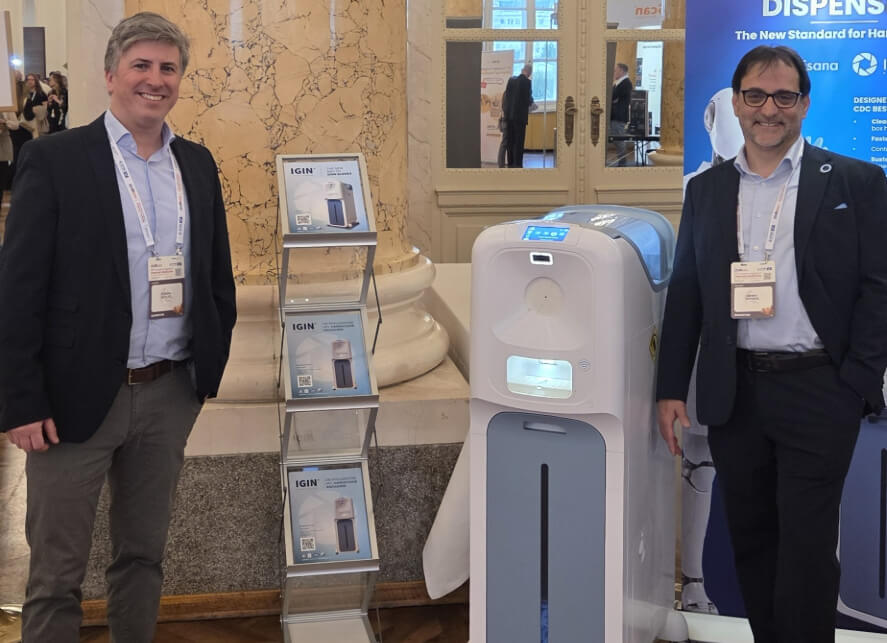
At ECIM 2026, IginTech® and Multisana presented IginSmart to clinicians, healthcare professionals, sustainability specialists, and operational decision-makers.
The objective was to introduce a new way of thinking about one of the most frequently used consumables in healthcare: the non-sterile medical glove.
Rather than focusing only on the glove itself, the discussion explored the complete workflow surrounding glove donning, including hand hygiene, dispensing, consumption, stock management, operational visibility, and responsible use of resources.
Together with Multisana, our exclusive distributor for Austria and Bavaria, we aimed to demonstrate how IginSmart may support healthcare organizations seeking a more structured, measurable, and consistent approach to glove workflows.
What we aimed to achieve
Our work at ECIM 2026 was built around 3 connected pillars:
Hygiene workflow support
IginSmart is designed to introduce a structured sequence before gloves are dispensed.
The platform requires the user to complete the defined hand-sanitization step before a pair of gloves is released. This supports a workflow aligned with the principle that glove donning should not replace appropriate hand hygiene.
Published infection-prevention guidance emphasizes that medical gloves must be used according to clinical indication and that glove use does not replace hand disinfection. IginSmart is intended to support this discipline through a controlled dispensing process.
Controlled dispensing and process consistency
The platform dispenses a defined pair of gloves without requiring users to reach into an open cardboard box or handle multiple gloves during selection.
This approach may support:
- More consistent glove access
- Reduced unnecessary contact with stored gloves
- A clearer donning sequence
- Better control of dispensing activity
- Greater standardization across healthcare environments
Clinical literature confirms that contaminated gloves may transfer microorganisms to surrounding surfaces and that correct glove technique and hand hygiene remain essential elements of infection prevention.
Consumption and procurement visibility
IginSmart records dispensing activity and provides operational data that may help healthcare organizations understand:
- When gloves are being dispensed
- Which periods show the highest activity
- How frequently the platform is used
- When refill activity may be required
- How consumption patterns develop over time
This creates a foundation for more informed procurement, inventory planning, and workflow evaluation.
From ECIM to University Hospital St. Pölten
Following the professional discussions around ECIM 2026, University Hospital St. Pölten expressed interest in exploring the technology through an initial field evaluation.
The purpose was to allow the hospital and Multisana to observe IginSmart in a real working environment and assess whether the platform could justify a more dedicated evaluation.
The activity enabled the collection of actual platform data and provided an initial view of glove-dispensing patterns across the evaluation period.
A total of 163 gloves were dispensed during the recorded activity period, including 155 after the introductory stage. The data showed identifiable usage patterns, with the highest activity during the mid-to-late afternoon, followed by late morning and early-shift periods.
This information demonstrates one of the central capabilities of IginSmart: transforming glove dispensing from an unmeasured routine into an activity that can be observed and reviewed.
What the evaluation allowed us to learn
The St. Pölten activity provided several valuable outcomes:
- Real-world dispensing data were collected
- Daily and hourly usage patterns became visible
- Peak periods of glove activity were identified
- Platform inactivity periods could be distinguished from active use
- Technical feedback supported product refinement
- Updated components were introduced during the evaluation
- Additional software improvements were identified for future implementation
This type of structured learning is important when introducing a new workflow technology into healthcare.
It allows the manufacturer, distributor, and healthcare organization to examine the practical use environment before defining a more focused evaluation model.
What IginSmart may offer healthcare organizations
IginSmart is intended to support healthcare organizations in several connected areas:
A structured donning workflow
The platform integrates hand sanitization into the dispensing sequence before gloves are provided.
Touch-reduced access to stored gloves
Users receive a defined pair without reaching into an open glove box.
Measurable activity
Dispensing data may provide visibility into usage patterns, peak activity, and refill requirements.
Procurement and stock awareness
Consumption information may support more informed stock planning and operational management.
Sustainability evaluation
Measured usage can create a basis for evaluating avoidable consumption, waste, logistics, and resource use.
Continuous improvement
Field activity generates practical information that can support product development, workflow refinement, and future evaluation design.
Supporting appropriate glove use
The future of glove management should not be based only on increasing or reducing consumption.
It should be based on supporting appropriate glove use, correct hand hygiene, controlled access, and measurable decision-making.
KRINKO guidance highlights that indication-appropriate glove use can support hand-hygiene practice, staff protection, and healthcare sustainability by helping reduce unnecessary consumption and waste.
IginSmart is designed to contribute to this broader objective by connecting glove access with a structured, measurable workflow.
The next stage
The initial evaluation at St. Pölten created a foundation for further discussion.
A future dedicated evaluation could examine:
- A clearly defined clinical area
- Baseline glove-consumption data
- Agreed usage conditions
- Defined evaluation periods
- Consumption patterns
- Refill activity
- Workflow impact
- Staff experience
- Resource-efficiency indicators
This would allow the hospital, Multisana, and IginTech® to explore the technology through an increasingly structured and evidence-oriented process.
Looking forward
Our collaboration with Multisana reflects a shared commitment to introducing innovation responsibly.
ECIM 2026 created the opportunity for professional dialogue. St. Pölten enabled an initial real-world evaluation. The next stage is to continue building evidence, refining the workflow, and exploring how IginSmart may support healthcare organizations seeking greater control, visibility, and consistency in non-sterile glove use.
At IginTech®, we believe that what is measured can be better understood, and what is better understood can be managed more responsibly.